
If you’ve been trying to make a change for the animals, you probably find yourself wondering if your actions can truly contribute to any tangible change. Especially because animal advocacy is a long-term game with several players, how can you possibly know that the solutions you’re using are working (or not)? How can you learn from your past experiences, or even celebrate small victories?
We understand your struggles because we have also gone through them. The good news is there is an extremely useful system that can help you navigate those challenges: Monitoring, Evaluation, and Learning (MEL). Whether you are a grassroots activist or an established organization, these frameworks will help get rid of confusing noises, create a clear path from daily activities to long-term goals, and make continuous learning and adaptation possible.
“...I was also able to separate more short- and medium-term objectives and outcomes from the more long-term goals which really helps to celebrate intermediate milestones while keeping our eyes on the bigger picture.”
Our team at Animal Alliance Asia (AAA) has partnered with The Mission Motor (TMM), MEL experts who have been supporting us on integrating the tools into our standard procedures. And today we’re beyond excited to share the tool and our learnings with you in this post. We hope that you will find this resource useful for creating a strategy specifically for your own pro-animal project!
What to expect from this post:
Monitoring, Evaluation, and Learning (MEL)
Theory of Change (ToC)
Defining the Problem & Stakeholders
Mapping our Theory of Change
Activities & Outputs
Outcomes
Impact
Assumptions and Risks
Monitoring & Evaluation (to be continued in the next post!)
Monitoring, Evaluation and, Learning
What does a Monitoring, Evaluation, and Learning system look like?
An MEL system consists of three distinct parts:
A Theory of Change
Monitoring
Evaluation
The Theory of Change is a tool that explains how you think your work will create an impact, by breaking down your activities, outputs, and the outcomes you want to achieve into clear steps.
Once these steps are clearly defined, you can use the Theory of Change to:
Write down the questions that naturally come up about your ToC
Decide what needs to be measured about your program in order to answer the questions you have
“One thing that stood out for me was the non-linear approach to complex, multi-layered programs. I think that helped a lot to visualize where we are at in the program. And where will the program go? There are many frameworks out there, and I also love the fact that when it comes to the ToC and MEL there is a lot of room to explore your own unique style of using the framework and labelling the framework to what an intervention would need. I would recommend this to every advocate who wants to evolve their programs to the next level.”
Some questions can be answered by collecting routine data on your outputs and outcomes; this is monitoring. Other questions will require a more in depth assessment of your work using additional data collection beyond your monitoring data; this is evaluation.
The insights gained from both monitoring and evaluation form the Learning component of MEL, and those learnings can be used to improve your program and update your Theory of Change. This process forms the MEL cycle of continuous improvement.
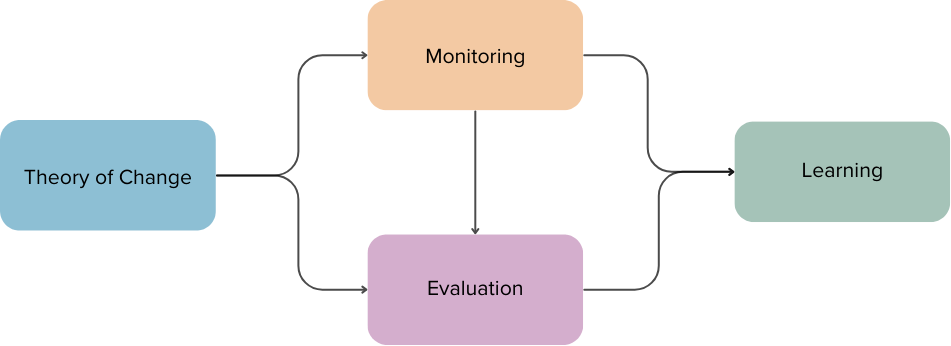
The MEL Cycle
When you are just starting out with MEL, your main focus should be on developing your Theory of Change, and then using it to plan some monitoring. We will start by focusing on ToC in this post, creating a blueprint of your project and how you think it will create impact. Then, we will use the ToC to layout a monitoring framework in the next post.
Theory of Change
“Imagine being able to visualize, analyze, and quantify your project, resources, impact, risks all before spending time or resources on a project which can save organizations and the movement so much time and money. This is a great tool for AAA. We really needed something holistic for AAA’s programs as they are culturally diverse and contextually complex. And the whole process was made extremely easy by The Mission Motor.”
At AAA, an organizational level Theory of Change (ToC) was developed by Ailya Khan, AAA’s Strategy Lead, with support from The Mission Motor. It serves as an umbrella framework guiding all of our programs, ensuring that they would strategically contribute to the impact we’re aiming for a positive change for farmed animals in Asia. For the sake of demonstrating, we will present you a simplified version of AAA’s ToC in the upcoming section, as well as another made-up example of a vegan school lunch program that will show how you can apply ToC to your own project.
Seven Country Directors at AAA have been leading and strategizing the New Waves Asia program in their own countries. After each of them building a ToC for their country’s program, they find that ToC helps them “see future possibilities, allowing them to be prepared to tackle foreseen challenges”, “define short-term impact”, and “add structure to the whole planning process”.
Defining the Problem & Stakeholders
Toolkit: PESTLE Analysis
A PESTLE analysis can be conducted while designing an intervention to better understand your context. It helps to identify the political, economic, social, technical, legal, and environmental factors relevant to your problem. Read more here.
Before we can map out how you’re changing the world, we first need to start with the problem you’re trying to solve. A clearly defined problem is crucial for developing a clear and effective solution, and there are many helpful guides available to help you define your problem step by step. As part of defining our problem, we also want to clearly define our stakeholders. These are the people we need to influence in order to create the changes needed to solve the problem. A program may have just one group of stakeholders or several, and mapping them out will help you to define exactly what change is needed in each group.
Toolkit: Stakeholder Mapping
This involves defining your stakeholders, categorizing them, and determining which are most important. Read more here.
When working with animals we run into a couple of important issues when defining our problem: we can’t speak with them to fully understand their needs, and the people we are trying to influence often don’t consider the needs of animals to be important. This means that we need to rely more on animal welfare and behavior research to understand needs, and we may need to invest more time into persuading people to care, or to use messaging that they care about more (e.g. economic, health or environmental reasoning instead of animal welfare).
For example, the main problem that AAA is trying to address is the high levels of animal consumption in Asia. We believe that a strong Asian animal advocacy movement is the key solution to this problem. So we conducted research in 2022 to understand factors that are hindering the growth and effectiveness of our movements. Here are three particular problems that we’ve identified:
The lack of culturally appropriate interventions in Asia
Insufficient funding that supports locally-led interventions in Asia
Limited training and mentorship opportunities for animal advocates in leadership in Asia
We then built a Theory of Change that maps out the logical steps of a solution to these problems, resulting in the impact we want to see in the world.
Mapping our Theory of Change
A Theory of Change (ToC) can be mapped out visually. Let’s take a look at some examples.
Firstly, we have an organization-level ToC, which covers all of Animal Alliance Asia’s work as an organization, addressing the problems we mentioned before. We ultimately want to see ‘positive change for farmed animals in Asia by reducing consumption of animals’, and that’s the impact we aim to create through our interventions.
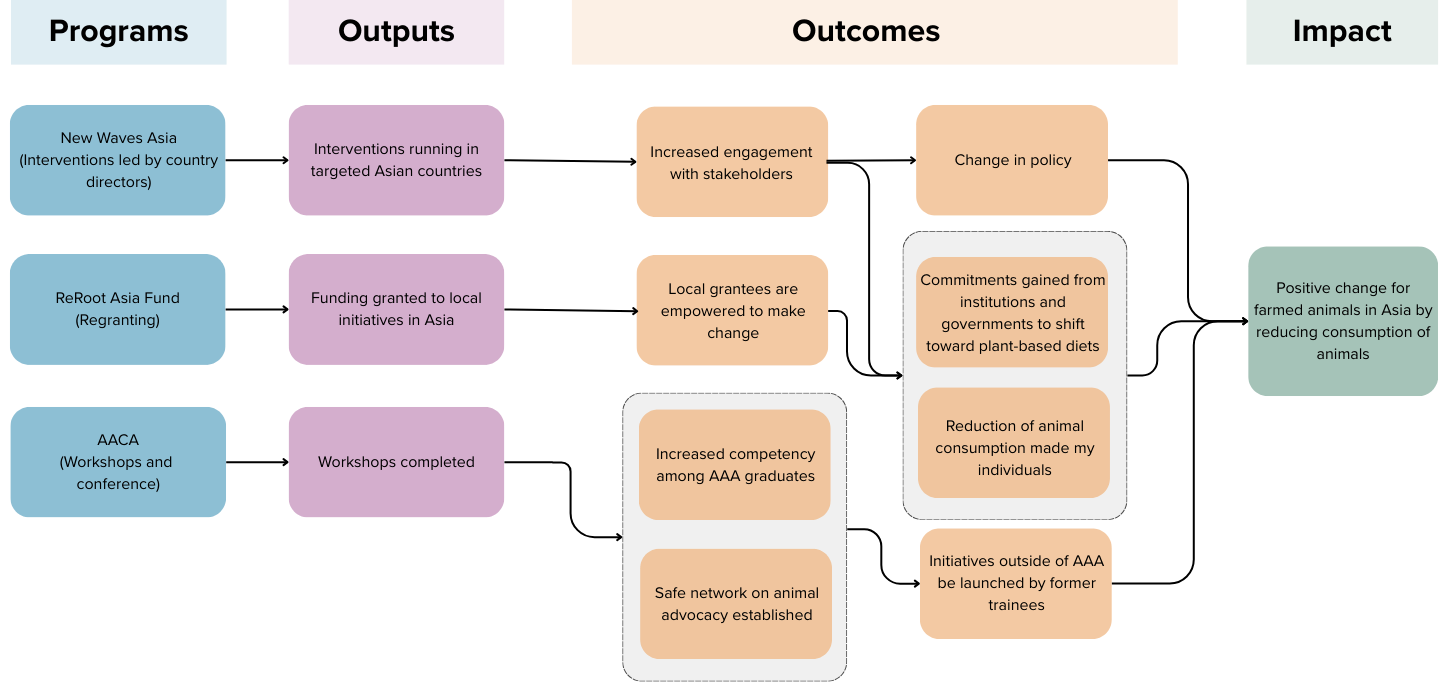
Simplified Theory of Change of Animal Alliance Asia
Since the ToC above is organizational-level, it encompasses a larger scale view of the movement, and is most useful for communicating your strategy to others. For a ToC that is useful for testing and improving your programs, you need to look in more detail at each program individually. We’d like to show you another ToC example that is more specific to one program which is more straightforward and more relevant to grassroots projects.
Let’s say that you want to solve the problem of animals being farmed for food (meaning that you want to reduce the number of animals farmed). You’re interested in influencing schools in your country to shift toward plant-based diets by inviting them to sign a pledge promising to provide vegan lunch once a week to their students. Then the following diagram is one way that your ToC can look.
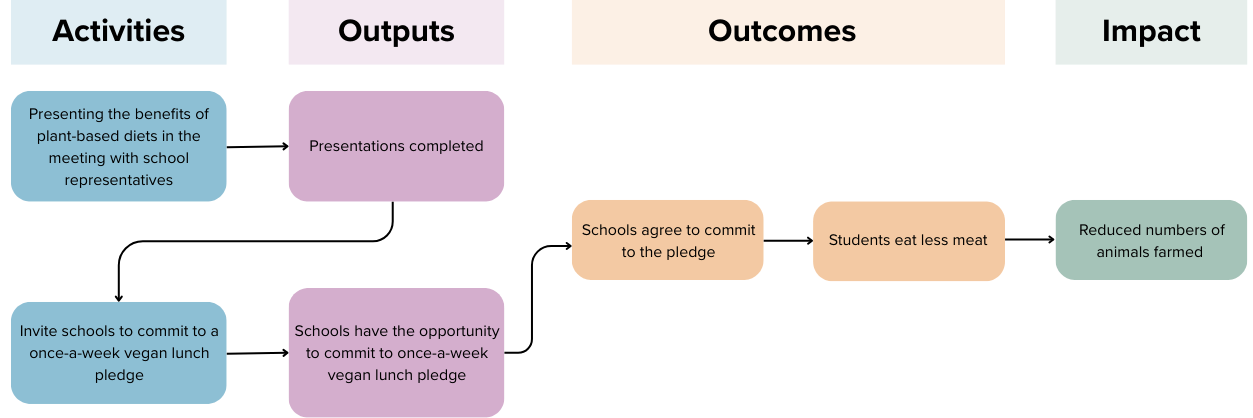
Example Theory of Change of A Vegan School Lunch Program
We can see from the diagram that a ToC can be broken down into three distinct sections:
Activities & Outputs = We do this…
Outcomes (Early, Intermediate, Final) = Which means our stakeholders will do this…
Impact = Resulting in this…
Activities & Outputs (We do this…)
This is where we define our activities and outputs, the parts of the ToC that we have complete control over. This should include any activities that are aimed at creating change directly with our stakeholders, and not activities that support the running of the organization e.g. fundraising or hiring. Each activity should have a corresponding output, which is the immediate and measurable result of the activity.
Let’s bring back the example of a vegan school lunch program. Here’s what the activities and outputs can look like.
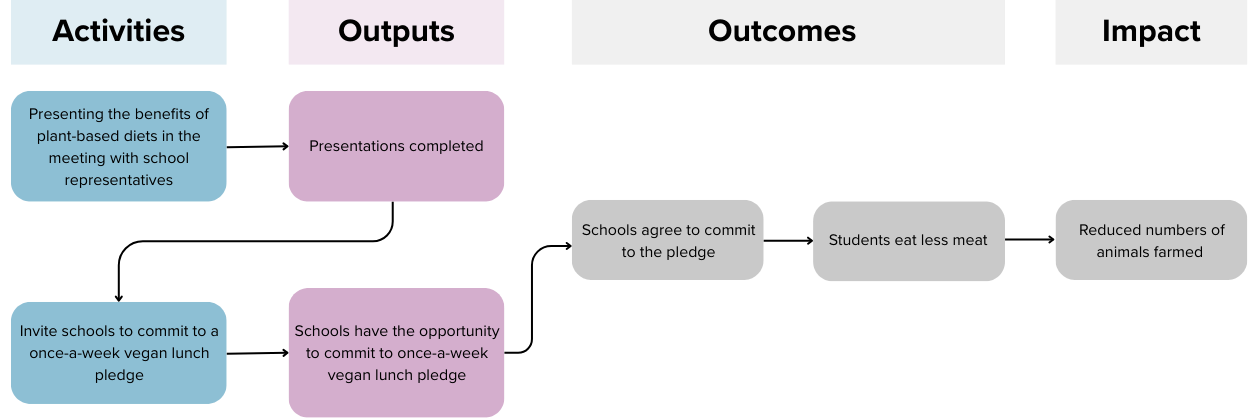
Activities & Outputs
As you can see, activities and outputs are the part of the ToC that involves our actions engaging directly with stakeholders, that is advocates ‘Presenting the benefits of plant-based diets in the meeting with school representatives’ (activity). Once it has happened, a direct result of that activity would be ‘Presentations completed’ (output). After finishing the presentation, you’d want to ‘Invite schools to commit to a once-a-week vegan lunch pledge’ (activity), then the ‘Schools will have the opportunity to commit to once-a-week vegan lunch pledge’ (output).
Outcomes (Which means our stakeholders will do this…)
“Reflecting on the outputs and outcomes of each activity really helps me strategize better.”
Toolkit: Behavioral Change Models
Before people engage in a behavior, there are certain factors that need to be in place. Models that try to capture these factors are called Behavioral Change Models. A basic example is the KAB model (Knowledge, Attitude, Behavior) which states that in order to see behavior change, the subject must first have sufficient knowledge and an attitude that is aligned with the behavior. The KAB model is an excellent model to start with as it is versatile and easy to apply. If you find it is not working well in your context, we also recommend looking at the COM-B (Capability, Opportunity, Motivation - Behavior) model which captures a higher level of complexity.
This is the most important part of the ToC, where our actions translate into changing the behavior of our stakeholders. This section should have early outcomes that are the direct result of our outputs, and those should flow into later outcomes that will often be related to the behavior change we want to see in our stakeholders. As we move to later outcomes, we have less direct control over whether they actually happen. It is therefore important to have a clear understanding of each logical step needed to create behavior change and we can address this by using Behavioral Change Models (see the toolkit below). For example, our activities and outputs are unlikely to create behavior change directly, so often we need to focus on changing the underlying attitudes and/or knowledge of a stakeholder before we can expect behavior to change.
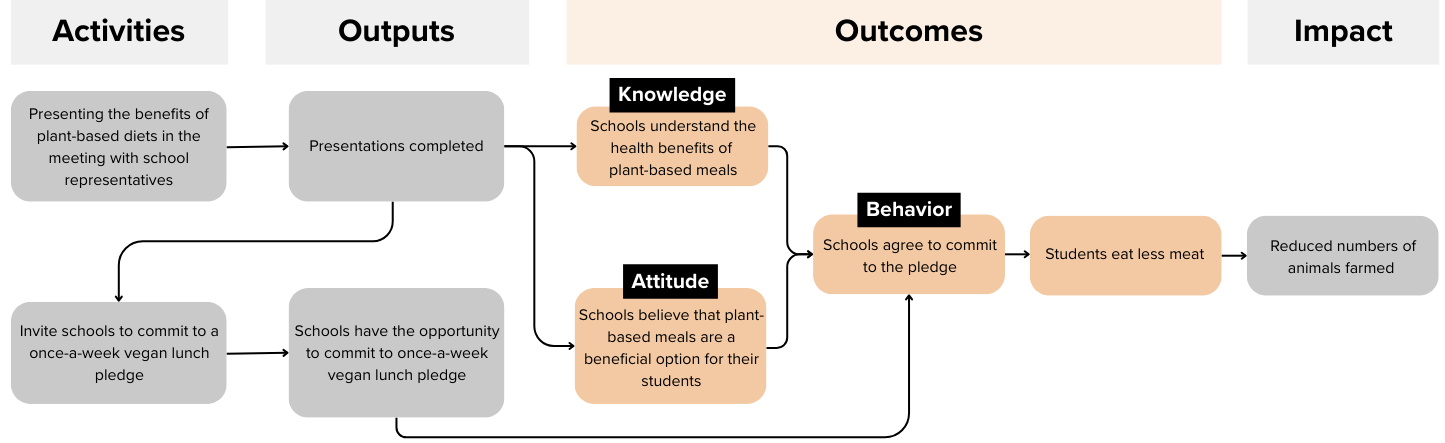
Outcomes (with the KAB model)
Coming back to our example ToC of the vegan school lunch program, you’ll see that the expected outcomes can be improved from the previous version using the KAB model (Knowledge, Attitude, and Behavior). The outcomes of presentation completion are ‘Schools understand the health benefits of plant-based meals’ (knowledge) and ‘Schools believe that plant-based meals are a beneficial option for their students (attitude). These two early outcomes lead to ‘Schools agree to commit to their pledge’ (behavior), in turn, results in ‘Students eat less meat. In other words, by increasing schools' knowledge of and positive attitudes toward providing vegan meals to their students, they will be more likely to take action by committing to the pledge.
Outcomes are different from activities & outputs because we don’t have full control over them. We cannot control whether the schools will agree to commit to the pledge nor will the students eat less meat. But these are the behavior changes we want to see happen among our stakeholders (schools and students).
Impact (Resulting in this…)
This is the final impact we want to see, and is closely tied to our problem. When our problem is fixed what does this look like?
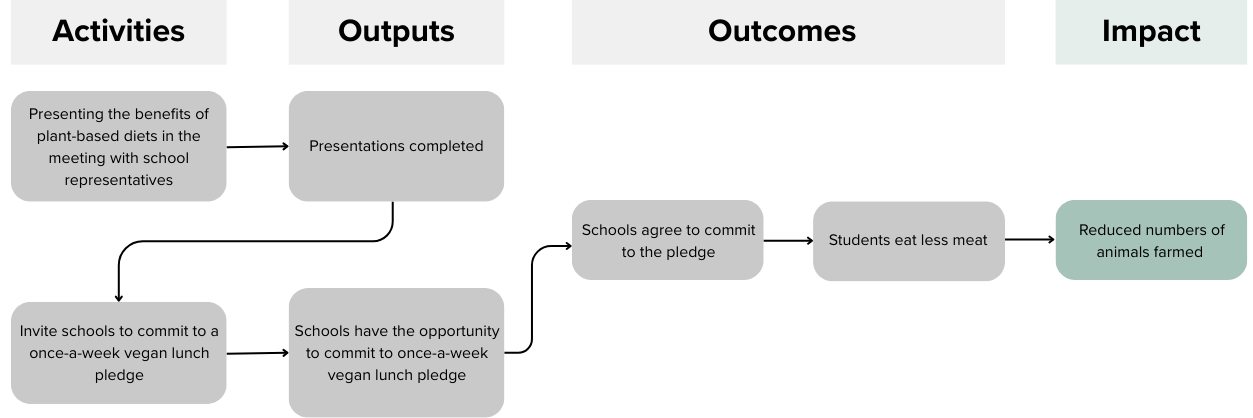
Impact
If the vegan school lunch program is planned to solve the issue of high numbers of animals farmed for food, the reality where said problem is fixed would be the numbers being decreased. So, the expected impact for this ToC would be ‘Reduced numbers of animals farmed’.
Assumptions and Risks
Any Theory of Change rests on certain assumptions that must be true in order for the theory to hold. Similarly there will be risks to the ToC which, if found to be true, will negatively affect its validity. Once you have mapped out your ToC, it is a useful exercise to name these assumptions and risks, and see which of them seem to be most important.
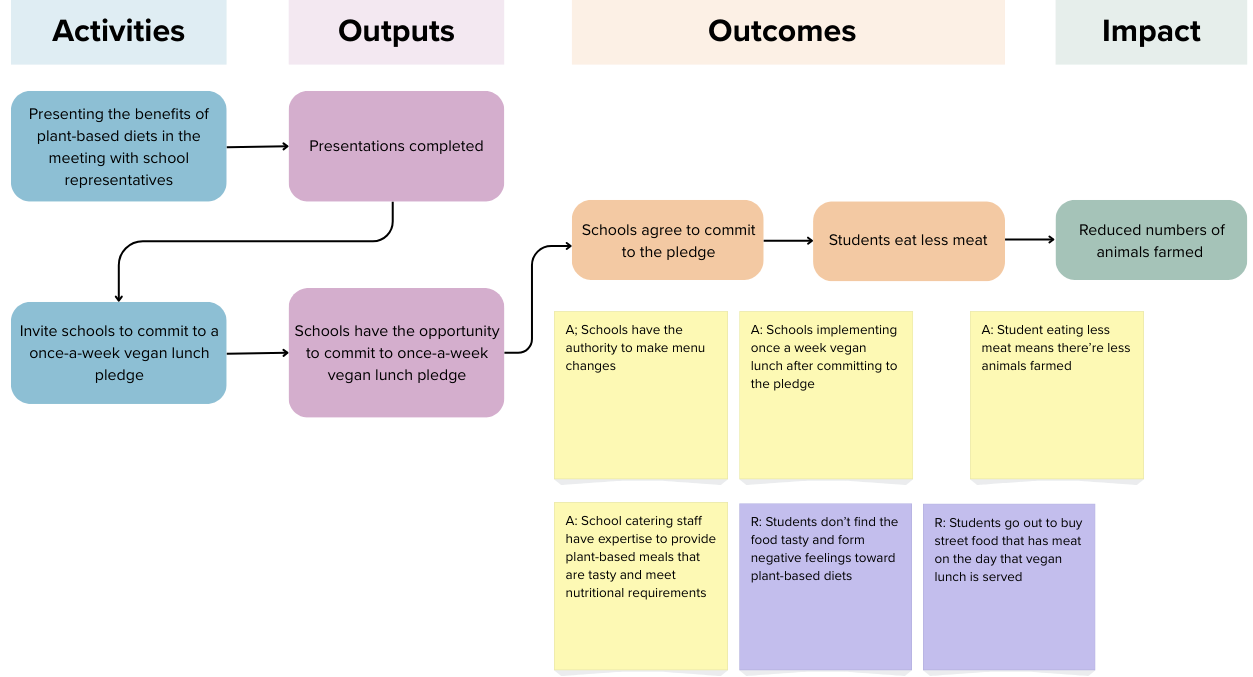
Assumptions & Risks
Let’s look at some examples of assumptions and risks within our vegan school lunch ToC .
Assumptions = Something that needs to be true so the ToC will work
School catering staff have expertise to provide plant-based meals that are tasty and meet nutritional requirements
Schools implementing once a week vegan lunch after committing to the pledge
Student eating less meat means there’re less animals farmed
Schools have the authority to make menu changes.
Risks = Something that if they’re true, the validity of the ToC will be negatively affected
Students go out to buy street food that has meat on the day that vegan lunch is served
Students don’t find the food tasty and form negative feelings toward plant-based diets
These assumptions and risks give us ideas for important elements to test in our Theory of Change. They can be very helpful for building an understanding of whether our program is working as expected.
If you’re thinking about about building a Theory of Change, here are some resources that we recommend:
NPC: Theory of Change in 10 Steps
This is a helpful and detailed guide to building a ToC
Pathways for Change: 10 Theories to Inform Advocacy and Policy Change Efforts
If you’re working on advocacy or policy change interventions this is worth reading to see some examples of relevant ToCs
Venngage: Visualizing Theories of Change
A blog post that looks at lots of different ways a ToC can be visualised
Finally when building a Theory of Change, here are some tips from us ✨
It is often best to build it from right to left. Start by defining your impact and then think about what final outcomes you would need to see in order for that impact to be created. Work backwards from there until you get to your activities. You may find that some of your current activities don’t fit as well into your theory of change as you first thought, and this process is enough in itself to cause you to change the work you are doing.
Make sure that you have included outcomes for all of the stakeholders involved.
Your outputs are in your control, the outcomes from those outputs are not in your control. This means that none of the outputs in your ToC should be dependent on stakeholders.
It should be based in theory; why do you think the changes you have mapped will happen that way? Ideally, you should review available literature or get feedback from other people who know about the problem you are trying to solve. This can be as simple as using AI to generate a Deep Research report.
It should be continuously evolving as you learn more about your program. It is unlikely that the first draft (or first several drafts) of your ToC will be an accurate reflection of reality. It is normal to update and adjust them as you continue to implement your program and learn.
Now that you understand the core components of a Theory of Change and how each part fits together, you're ready for the next crucial step: bringing your ToC to life! In our next post, we'll dive into the monitoring, evaluation, and learning (MEL) cycle, the process that transforms your ToC from a static plan into a dynamic tool for continuous improvement. You'll discover how to systematically collect insights from your advocacy work, identify what's actually driving change, and refine your approach based on real-world evidence, keeping your ToC sharper and more effective over time.
Until then, take some time to think about your own advocacy projects. What evidence are you already gathering? What questions do you have about whether your approach is working? Write down any observations you have, because in the next post, we'll show you exactly how to turn those insights into action. We're excited to continue this journey with you toward creating even greater impact for animals!
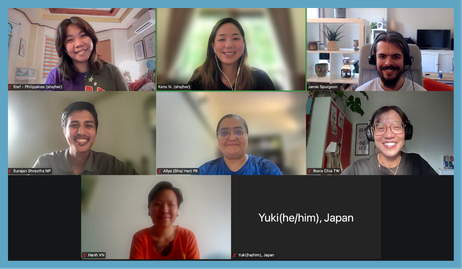
A big THANK YOU to Jamie and The Mission Motor for supporting our team and sharing these incredibly helpful tools on today’s blog!